I’ve watched a lot of nature documentaries. I’ve seen lions take down buffalo, orcas flip great white sharks, and trapdoor spiders catch birds. But nothing — and I mean nothing — prepared me for footage of a fingernail-sized ant dragging a poisonous toad to its death while the toad just sits there, helpless.
That’s what researchers in Australia’s Northern Territory walked into one morning. They weren’t looking for a breakthrough. They were just doing field surveys near a muddy pond. What they found instead was something that genuinely looked, as one scientist put it, like it came straight out of a science fiction movie.

And it might just be the best ecological news Australia has had in about 90 years.
The Mistake That Started Everything
To understand why this ant discovery matters so much, you have to go back to 1935 — and one of the worst ideas in agricultural history.
Australian sugar cane farmers were being destroyed by cane beetles. Someone, somewhere, decided the solution was to import a predator. They settled on the cane toad, shipping in 102 of them from Hawaii with the confidence of people who had absolutely no idea what they were about to unleash.
The plan failed immediately. The beetles lived high up on the cane stalks. The toads stayed on the ground. They never even met. But the toads did meet everything else — every insect, every small animal, every native species that crossed their path. And then they started breeding.
Those 102 toads became 200 million. They spread across thousands of miles at a pace of nearly 40 miles per year, pushing into the Northern Territory, Western Australia, and New South Wales like, as one researcher described it, “an unstoppable green wave.”
The real catastrophe wasn’t just the sheer numbers. It was the poison.
Australia is an island continent. Its animals evolved in isolation for millions of years and never encountered a creature that secretes bufotoxin — a cardiac poison potent enough to kill a crocodile. When a native quoll snake sees a cane toad, it sees dinner. When it bites down, the glands behind the toad’s head release a white, waxy slime. Within minutes, the snake is dead.
In some regions, populations of native predators dropped by more than 90% as the toad wave arrived. The ripple effects were devastating — remove the top predators, and everything below them spins out of control.
Fences didn’t stop them. Traps barely dented the numbers. Gene modification programs were expensive, complicated, and years away from deployment. For decades, Australia was losing.
The Ants Nobody Was Watching
Here’s what makes the discovery so strange: the solution was already there. Living in the dirt, doing its thing, completely overlooked.
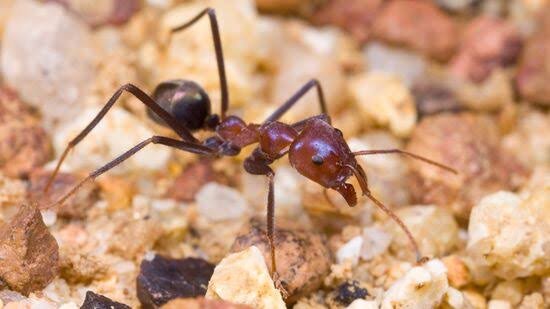
Meat ants — Iridomyrmex purpureus — are a tough, aggressive species that lives in large colonies across tropical Australia. They’re already part of the ecosystem. They’ve been there for thousands of years. But nobody had ever seriously documented them hunting cane toads, because nobody thought it was possible.
When the research team, including scientists like Georgia Ward-Fear and Rick Shine, started watching the ponds where baby toads were emerging, they saw something that upended everything they assumed about the toad invasion.
The toadlets — called metamorphs, freshly transformed from tadpoles — were crawling out of the water in massive numbers. Each one is roughly the size of a fingernail. Each one still carries enough toxin to kill a small animal. And each one uses the same survival strategy as its parents: sit still, stay calm, and let the poison do the work.
Against a snake or a lizard, that strategy is basically infallible.
Against meat ants, it’s completely useless.
“The ants are completely immune to the poison,” the research showed. They don’t have the same cardiovascular system the toxin is designed to disrupt. So while the toad sits perfectly still waiting for its attacker to give up, the ants just… keep going. They grab a leg, the body, anything they can reach, and they start pulling — dragging the toad back toward the nest while it’s still alive.
In some documented areas, the ants were eliminating up to 98% of emerging toadlets.
That’s not a dent in the population. That’s a wall.
The Cat Food Gambit
Knowing the ants could do this was one thing. Getting them to do it consistently, in the right places, at the right time — that was the challenge.
The toads were moving into new territories faster than the ant colonies could naturally spread. So the researchers needed a way to concentrate the ants near the emergence zones without disrupting the broader ecosystem.
The solution they landed on sounds almost embarrassingly simple.
Cat food.
Cheap, tinned, fishy-smelling cat food, placed near the edges of ponds just before the toadlets were due to emerge. Meat ants, it turns out, are powerless against the smell of it. Within minutes of opening the cans, the ground around the pond would be crawling with thousands of extra ants, drawn from colonies across a wide radius.
When the baby toads started crawling out of the water, they didn’t find a quiet muddy bank. They found an army.
In areas where the cat food bait was used, ant numbers increased by more than four times. The predation rate on emerging toadlets went through the roof. For a few dollars spent on supermarket cat food, researchers were able to protect specific high-value zones — national parks, wildlife corridors, community backyards — from the next generation of the invasion.
As one member of the team put it: “If we can take that water up off the ground and get it away from cane toads, then they can’t soak up water through their skin — they simply can’t survive. They dry out and perish.”
The bait method made that happen by removing the toadlets before they ever got the chance.
The Catch
This isn’t a complete solution. It’s important to be honest about that.
The ant strategy only works on metamorphs — the baby toads in their first few days on land. A full-grown cane toad can weigh up to four pounds and has skin like wet leather. A meat ant trying to take one down would have zero effect. The adults are simply too large, too tough, and too well-defended.
But here’s the strategic logic: if you stop the babies, you eventually stop the population from growing. You’re not eliminating what’s already there — you’re preventing the next wave. It’s a long game, and it requires sustained effort near breeding sites. But it’s a game that, for the first time in 90 years, Australia actually has a chance of playing.
What nobody expected was how quickly this went from a research finding to a community movement. Once word spread that a few cans of cat food could protect a local pond, ordinary Australians started doing it themselves. Homeowners near breeding sites. Conservation volunteers in national parks. It became grassroots without anyone planning it that way.
What This Actually Means
I keep coming back to the detail that feels most remarkable about this whole story.
The ants were already there. They didn’t need to be engineered, introduced, or funded. They were living in the dirt beneath the problem the entire time, immune to the one defense that made the cane toad seem invincible to everything else.
It took humans 70 years and hundreds of millions of dollars in failed interventions to notice that a native insect had already figured this out.
That says something worth sitting with — about how we approach ecological crises, about the solutions we overlook because they seem too small or too unglamorous, and about the tendency to reach for expensive complexity when the answer is sometimes already in the ground.
The cane toad problem isn’t solved. Two hundred million toads don’t disappear because of cat food and ants. But the trajectory has shifted, and it shifted because of one of the smallest creatures in the Australian bush.
The big guys — the crocodiles, the snakes, the monitor lizards — couldn’t crack the toad’s defenses. A bug with no blood and no heartbeat did it in seconds.
Nature has a dark sense of humor sometimes. But on this one, at least, it’s working in Australia’s favor.
Think the meat ant solution can scale to protect the whole continent — or is this just a small win in a much bigger war? Drop your take below.